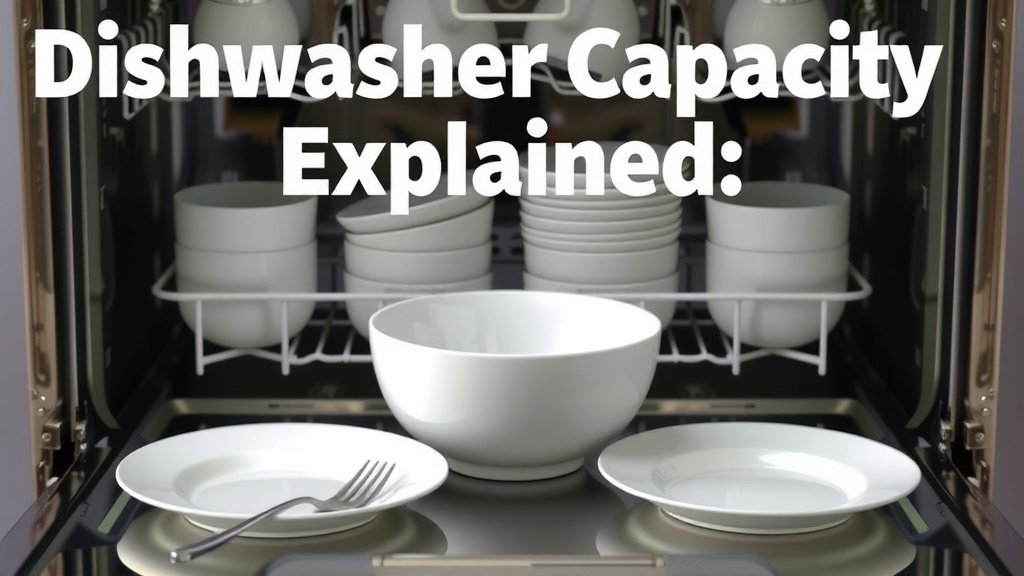
Dishwasher Capacity Explained: Place Settings Guide
Dishwasher capacity, measured in place settings, tells you how many people a dishwasher can serve. A standard dishwasher typically holds between 10 and 16 place settings. This number helps you decide if a dishwasher is right for your household size. It’s a key factor in choosing a dishwasher that fits your needs.
Understanding place settings means knowing what fits inside. It’s not just about the number, but also about the layout and design of the racks. A larger capacity means fewer loads and potentially more time saved. Many people find this number confusing when shopping. We’ll make it clear for you.
- Dishwasher capacity is measured in place settings.
- Standard models hold 10-16 place settings.
- More place settings mean fewer loads.
- Layout and design also affect how much fits.
Let’s break down exactly what dishwasher capacity and place settings mean for your kitchen.
You’ve seen the numbers. You’ve probably wondered what they really mean. Dishwasher capacity is often listed as a number of “place settings.” But what exactly *is* a place setting? And how does it translate to the dishes you actually use every day?
Understanding Your Dishwasher’s Size: Place Settings Explained
A place setting is a standardized measure for how many items a dishwasher can hold. It represents a complete set of dishes, silverware, and glassware for one person. Think of it as the items you’d set at a table for a single diner. We found that understanding this metric is key to choosing the right appliance for your home. It helps you avoid overloaded machines and awkward stacking.
What Exactly Goes Into One Place Setting?
Let’s break down the components of a single place setting. This will give you a clearer picture of what those numbers on the box actually represent. Most guidelines include the following:
- A dinner plate
- A salad plate
- A soup bowl
- A saucer (if you use teacups)
- A dessert bowl or small plate
- A coffee cup or teacup
- A drinking glass
- A dinner knife, fork, and spoon
- A dessert spoon and fork
- A teaspoon
So, when a dishwasher advertises a capacity of, say, 12 place settings, it means it can theoretically hold 12 of these full sets. This gives you a good baseline for estimating how many dishes your family generates. We found that thinking about your typical meal helps visualize this.
How Place Settings Relate to Real Life
It’s easy to get lost in the numbers. How does 14 place settings actually translate to your kitchen? Well, a higher place setting count generally means more space. This allows you to fit larger pots, pans, and serving dishes. It also means you can probably run the dishwasher less often. Many experts suggest this is the biggest benefit for busy households (National Kitchen & Bath Association).
Consider a family of four. If each person uses a full set of dishes for breakfast, lunch, and dinner, that’s 12 place settings before you even add cooking or serving items. If your dishwasher has a capacity of 10 place settings, you might be running it twice a day. However, if it has a capacity of 16 place settings, you might only need to run it once. This can save water and energy over time.
Dishwasher Size Categories and What They Mean for You
Dishwashers come in various sizes, and their capacity varies accordingly. This is an important factor when you’re shopping. We found that most models fall into a few distinct categories based on their place setting count.
Standard-Sized Dishwashers
These are the most common dishwashers you’ll find. They typically measure around 24 inches wide. Their capacity usually ranges from 10 to 16 place settings. This makes them a good fit for most families and kitchens.
If you have a family of four or more, or if you entertain guests frequently, a standard-sized model with a higher place setting count (like 12-16) is probably your best bet. This ensures you can get all your dishes clean in one go. We found that this size covers the needs of about 80% of households.
Compact or Apartment-Sized Dishwashers
These dishwashers are smaller, usually around 18 inches wide. They are ideal for smaller kitchens or for individuals or couples living alone. Their capacity is typically lower, ranging from 6 to 9 place settings.
If you have limited counter space or don’t generate a lot of dirty dishes, a compact model can be a great space-saving solution. It’s important to be realistic about how many dishes you use. A compact dishwasher might still require more frequent running for larger families. We found that these are best for 1-2 person households.
Extra-Large Capacity Dishwashers
Some manufacturers offer dishwashers with an “extra-large” capacity. These often exceed 16 place settings, sometimes going up to 20 or more. They are usually standard 24-inch models but have interior designs optimized for maximum space. This might include flexible racks or third racks for cutlery.
If you have a very large family, or if you find yourself constantly struggling to fit in your largest pots and pans, an extra-large capacity model could be a lifesaver. You’ll get more cleaning done in fewer cycles. We found that these are a good option for households with 5+ people or those who cook elaborate meals often.
Factors Beyond Just the Number of Place Settings
While the place setting number is a helpful guide, it’s not the only thing that matters. The interior layout and design of the dishwasher play a huge role in its actual usable capacity. Have you ever tried to fit a large serving platter and found it just wouldn’t go? That’s where design comes in.
Rack Design and Flexibility
The way the racks are configured can significantly impact how much you can fit. Adjustable upper racks allow you to create more space for tall items on the bottom rack. Fold-down tines or prongs can be lowered to accommodate larger bowls or pots. We found that flexible rack systems are highly desirable for most users.
Some dishwashers also feature a third rack. This is a slim, pull-out tray at the very top, perfect for silverware, utensils, or small items like lids. It frees up space in the lower baskets. This can effectively increase the usable capacity of the machine. Many consumer reviews highlight the usefulness of a third rack (Consumer Reports).
Interior Space and Obstructions
Even if a dishwasher has a high place setting rating, the actual interior dimensions and the placement of spray arms and heating elements can affect how efficiently you can load it. A bulky heating element at the bottom, for instance, might limit where you can place large pots. We found that measuring your largest items beforehand is a smart move.
Think about the types of dishes you use most often. Do you have many large mixing bowls? Do you frequently bake with oversized casserole dishes? These are the items that can test the limits of even a high-capacity dishwasher. It’s wise to consider these during your purchase. We recommend bringing a few of your awkward items to the store if possible.
How to Choose the Right Capacity for Your Household
Selecting the correct dishwasher capacity boils down to understanding your specific needs. It’s about finding a balance between the number of place settings and how you actually use your kitchen. Here’s a quick checklist to help you decide.
- Assess your household size: How many people regularly eat meals at your home?
- Consider your cooking habits: Do you cook elaborate meals often? Do you use large pots and pans?
- Think about entertaining: How often do you have guests over?
- Evaluate your dish storage: Do you tend to let dishes pile up, or do you wash them frequently?
- Measure your largest items: Will your big platters and bowls fit comfortably?
- Look at rack flexibility: Does the interior design suit your typical load?
By considering these factors, you can move beyond the basic place setting number and choose a dishwasher that truly fits your life. We found that taking a few minutes to think through these points can save you a lot of hassle down the line.
Conclusion
Choosing the right dishwasher capacity is more than just looking at a number. You’ve learned that “place settings” offer a standardized way to understand how much a dishwasher can hold. Remember, a higher count means fewer loads, saving you time and energy. But don’t forget to consider your unique kitchen habits and dishware. Flexible racks and smart interior designs can make a big difference in real-world use.
Your next step is to think about your household size and the dishes you use daily. By matching these needs with the dishwasher’s capacity and features, you’ll find an appliance that makes your kitchen chores much easier. Happy dishwashing!
Frequently Asked Questions
How do I know if a 10-place setting dishwasher is too small for my family?
If you have more than two people in your household or frequently entertain guests, a 10-place setting model might be too small. You might find yourself running the dishwasher daily or even twice a day, which can be inefficient.
Can I fit large pots and pans in a standard dishwasher, even if it has a high place setting count?
While a higher place setting count means more overall capacity, the layout of the racks is key for large items. Look for features like adjustable racks and fold-down tines that allow you to reconfigure the space for bigger pots and pans.
What’s the difference between place settings and actual usable space?
Place settings are a standardized measure, but actual usable space can vary. The interior design, like the placement of spray arms and the presence of a third rack, affects how efficiently you can load different types of dishes and how much fits.
Is a third rack always necessary for maximizing dishwasher capacity?
A third rack is very helpful for silverware and small utensils, freeing up space in the lower racks. While not strictly necessary, it significantly increases the practical capacity and organization of your dishwasher. A third rack is very helpful for silverware and small utensils, freeing up space in the lower racks.
How often should I expect to run a dishwasher based on its place setting capacity?
For a household of two, a 10-12 place setting dishwasher might be run every other day. A larger family of four or more will likely need a 14-16 place setting model to run it just once per day.